

In this article, you will learn how to reach 100% of searchers with real estate websites while saving money. We will also briefly discuss best practices and how to get more inquiries for your property. In addition, we will delve a little into math…yes, math—it sounds worse than it is, but it is extremely important for you and your success!
Depending on the region and country, there are various real estate websites that appeal to different target groups. Unfortunately, there is no way around this, and if you want to pitch your property, you should check for yourself which platform in your region has the most traffic—i.e., the most people searching for your type of property (keyword: target group). Read more about this in the article.
- What is a real estate website?
- What are the costs involved in creating an advertisement on a real estate website?
- How to find out which Real estate website is the “right” one
- How many different real estate websites should you use for the same listing?
- How do prospective buyers search for properties on the real estate website? How do they go about it?
- How to advertise on a real estate website
- How property seekers behave in property advertisements
- Optimization measures in real estate advertisements for long texts
- Trial and errordo + measure + evaluate + improve
- Summary
- Sources
- You may also be interested in
What is a real estate website?
Real estate websites are websites where professionals such as real estate agents and project developers, as well as private individuals, advertise properties for sale or rent.
What are the costs involved in creating an advertisement on a real estate website?
Every listing costs money, and not just because of the fees charged by the real estate website.
The following fixed and variable costs (the basics of cost accounting) are incurred with each advertisement:
- Costs for the platform itself (advertisement costs)
- Costs for various additional products in the advertisement
- Various software costs for interfaces between the broker’s website and the real estate portal
- The content costs for visualization (photographer, floor plan, home staging—possibly already with AI, etc.)
- The cost of creating the advertisement (time x hourly rate = working time)
- Processing inquiries from potential buyers of the property via telephone or email (time x hourly rate = working time)
- Working time for sending exposés to prospective buyers
Of course, there are significantly more costs involved in marketing the property, but I am not including those in the calculation here.
Tip: The main work involves creating the content (if you do this yourself) and conducting viewings.Creating content is of utmost importance, as it should make your property stand out from the others on the real estate website.
With perfect content, you’ll outperform the competitor! You’ll shine brighter than everyone else!
You can save money by being selective. Every inquiry and every call regarding your real estate listing should be checked in advance to ensure that the target group is appropriate. If you don’t do this, it will cost you money!
A trend study conducted by IMMOBILIENSCOUT24.AT revealed that:
On average, property seekers need 5.2 viewings. Tenants need around 3.4.
Conclusion: I recommend that you keep track of your viewings statistically. If you need significantly more viewings than mentioned above for your properties, I would start optimizing.
How to find out which Real estate website is the “right” one
Since real estate websites are generally used by people looking for real estate, the “magic” number is the traffic (number of users in a certain period of time) of the site in question.
The thing is, you don’t usually find out how high the traffic is on the various real estate websites.
To this end, I recommend that you conduct research, regardless of the size of your company. What does this mean for you?
To find out the traffic, you need a “special tool.” These are companies such as SEMRUSH or AHREFS, etc. These tools are not free, but they don’t cost a fortune either. You can get started for around €30 per month. What’s more, you usually only need them once.
If you notice that a portal you have chosen is generating no or significantly fewer enquiries than usual, you should check the traffic on that site again. It could be that it has fallen behind in competition with other real estate websites.
The largest real estate websites in Austria are www.willhaben.at and www.immobilienscout24.at .
WILLHABEN.AT states on its homepage that 87.1% of people searching for real estate use willhaben.
How many different real estate websites should you use for the same listing?
As we have already learned, WILLHABEN.AT covers a large number of property seekers. However, this also means that we cannot get by with just one real estate website.
This coincides with two things, namely:
- A 2016 study on the search behavior of prospective real estate buyers (not representative)
- A query about the traffic of the largest real estate websites in Austria via AHREFS
Figure 1 below shows the responses from people searching for real estate as part of my master’s thesis. It is clear to see that around 70% of respondents searched on willhaben.
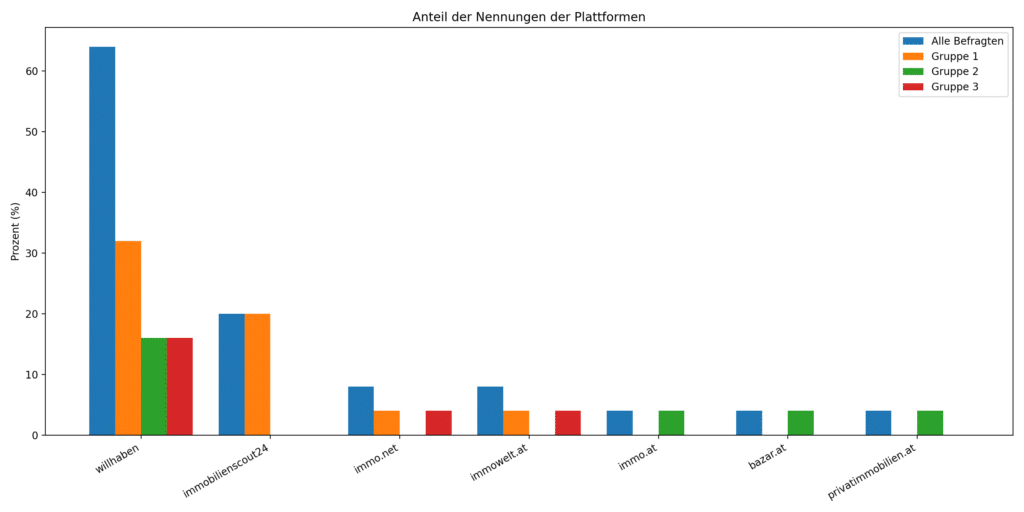
As can be clearly seen here, there are basically only two real estate websites of interest (which corresponds to internet research).
The AHREFS query conducted in February 2026 confirmed the findings of the older study. WILLHABEN.AT and IMMOBILIENSCOUT24.AT record by far the highest traffic. After that, there is a long gap.
Tip: I recommend using only 2 to a maximum of 3 of the largest real estate websites. Firstly, it saves you unnecessary costs and secondly, you can invest the money you save in creating top-quality content (e.g., photographer).
For those of you who are still skeptical, I recommend simply noting down which real estate websites the inquiries come from. You will then quickly realize which ones you should focus on and which portals are a waste of money.
Brilliant: If you only use two platforms, you’ll save money in several areas, namely:
- The redundant real estate websites themselves
- Any interface between your real estate agent website and the real estate websites
- Costs for various additional products from real estate websites
How do prospective buyers search for properties on the real estate website? How do they go about it?
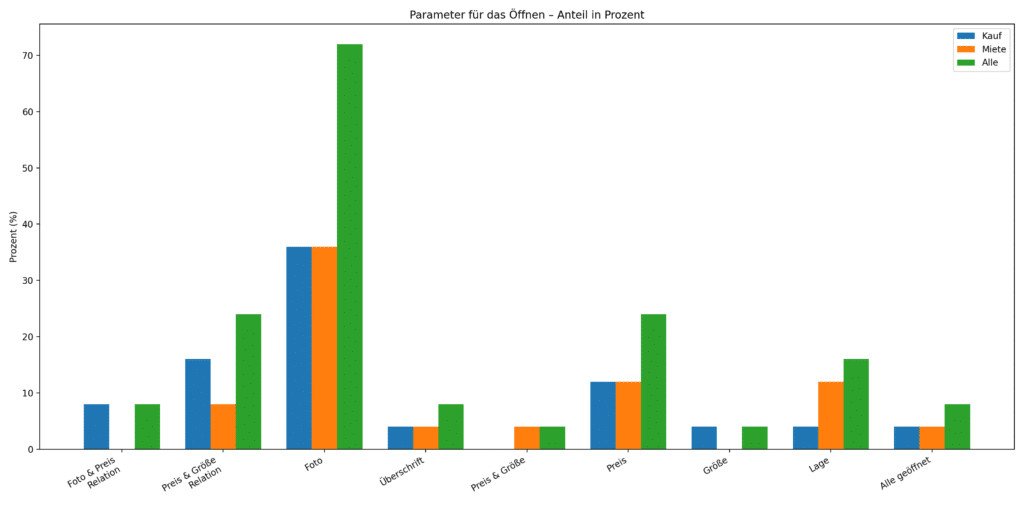
If you know this, then you clearly have an edge over the competition! Let’s take a closer look at the graphic below (Fig. 2). What stands out to you? Which points do you identify as the driving force behind opening a real estate listing?
I can see three key factors. If the price isn’t right, it’s going to be difficult. If the photo isn’t right, you won’t attract much attention, if any, and your ad might not even get opened.
With a great photo, you can set yourself apart from the rest of the ads.
Tip: Your goal should be to agree on a realistic price with the seller when you list the property.
I also recommend having professional or semi-professional photos taken.
Why?
This generates attention and emphasizes the value of your offer.
How to advertise on a real estate website
Before you advertise your property, I recommend asking yourself the following questions:
- Who is my target audience for this property?
- What is the absolute best thing about the property?
- What can I do/highlight—should immediately catch the eye?
Are you selling a run-down apartment? Then please do NOT write “DIY project” or anything similar. First, it sounds like work! Second, your target audience is not DIY enthusiasts.
Your target group includes, for example, people who are good with their hands
and who want to buy a property at a reasonable price so they can fulfill their dream of owning their own home by doing a lot of the work themselves.
OR
People who want to buy cheaply, renovate, and then sell at a profit.
How property seekers behave in property advertisements
If a property seeker has noticed your property AND decided to open the listing, you are unfortunately still far from being in the clear. The graphic below, Fig. 3, shows how prospective buyers view property listings.
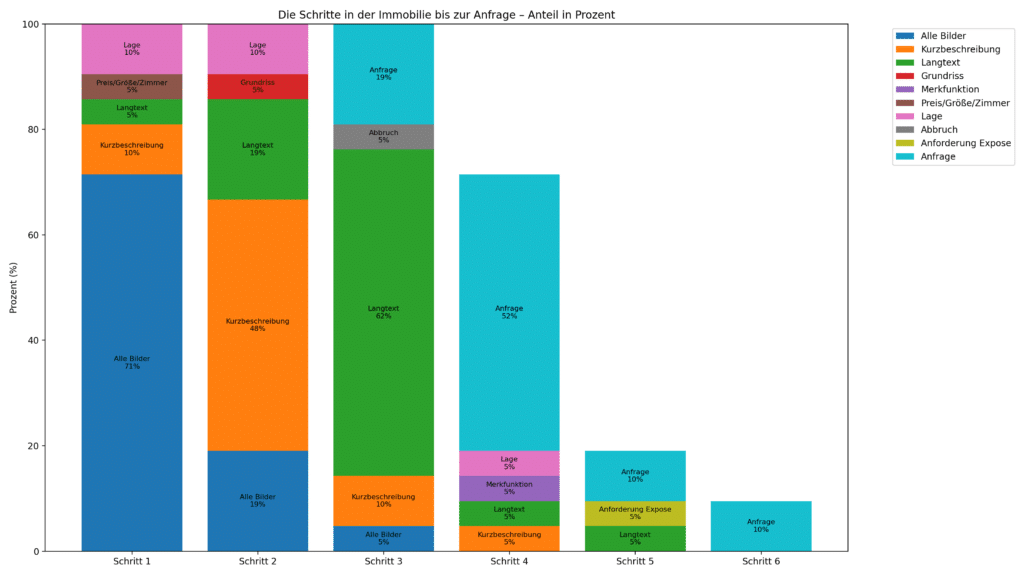
To illustrate: Prospective buyers need between 3 and 6 steps before they submit an inquiry to the seller or real estate agent. If anything does not suit the prospective buyer at any stage, they will abandon the process =>EXIT.
When inquiries about the property come in, it’s up to you to:
Select!
Summary:
- Step 1: 71% stated that they had initially viewed all images
- Step 2: 48% stated that they had read the brief description.
- Step 3: 62% stated that they had read the long text
- Step 4: 52% stated that they had already submitted a request here.
Optimization measures in real estate advertisements for long texts
Benefits + benefits + benefits …. Target group, target group, target group … Generate emotion …
That is the top priority. You can read about how to take real estate photos that evoke EMOTION in the blog post about real estate photography.
The photos are the gateway to the ad, but the text triggers the final action on the part of the interested party!
Tip: Create an Excel sheet for recording real estate properties. Not one for all types of real estate, but a separate one for each type of property.
Everything you need to know should be listed there in case a potential buyer asks you about it. There’s nothing worse than not knowing the answer.
Why standardized property recording using Excel spreadsheets is worth its weight in gold:
- You can’t forget anything
- Standardized means efficient, efficient means cost-optimized
- All key data at a glance
- You seem incredibly competent
Do not use abbreviations. You do not know the level of knowledge of the prospective buyer. Make it as easy as possible for them.
No technical jargon (if absolutely necessary, please explain the term), e.g., HWB (what does this mean for your customer); operating costs (how are they calculated, what is not included, etc.) and much more.
The long text should be tailored to the target audience and, like the images, trigger positive emotions in them.
Example: Let’s say you are selling a house. I am now going to make a claim (please NEVER do this—claims are poison):
I would say that most single-family homes are or have been occupied by families. If that is the case, then I would ask
- why the seller lived here
- What he appreciates most about the area
- Why he enjoyed living here so much …
- …
If there is a pool in the garden and you want to advertise it, this will set off alarm bells for parents with small children. However, if the pool is clearly visible from the kitchen window, I would include this in the description.
What about kindergartens, schools, public transportation, doctors, etc.? Don’t just write that there are doctors in the area. Write that there is a general practitioner in town, so that if you are sick, you don’t have to travel far to see a doctor. You should formulate the benefits.
THE INTERESTED PARTY MUST MENTALLY MOVE INTO THE PROPERTY!!!
Don’t sell the property, sell the feeling. How did it feel to live here?
Don’t write too flowery. Try out different styles and track the requests.
Trial and error
do + measure + evaluate + improve
Not measuring the success of your advertising measures/real estate ads is like flying blind.
Real estate websites generally use the following key figures:
- Number of views
- Number of clicks
- Contacts
- Storage
The number of views tells you how “popular” the area or property is. Why is this important? The real estate agent then knows what is currently “in demand” on the market.
The number of clicks indicates how often the ad was clicked.
This metric alone is insignificant. What is interesting is the CTR (click-through rate). The CTR compares the clicks IN the ad to the impressions!
Here is the formula:
CTR = (NUMBER OF CLICKS / IMPRESSIONS) x 100
Example: Five people clicked on the ad to find out more. However, 500 people saw the ad.
CTR = (5/500)x100
CTR = 1%
Goal: Please forget about what value constitutes a good or bad CTR. Increasing your CTR is the key to success. The CTR is also a very good metric for measuring the success of your photos.
The better your real estate photography, the higher the number of clicks in relation to impressions.
The contacts must also be documented. However, it is essential to document where the contact came from. Where did he/she find out about the property? This allows you to track the success of various platforms as well as offline advertising measures (e.g., for sale sign).
The saves are useful and show how many people were interested in the property. If the property was saved unusually often but rarely inquired about, then something is wrong. In this case, you should analyze and refine your approach.
Summary
If you’ve actually read the article to the end, then congratulations! Your thirst for knowledge is incredible! You really want to grow, and I think that’s great!!
The approach described here is part of Total Quality Management and falls under the data-driven method known as Six Sigma. It is the supreme discipline and, to my knowledge, is used very little by real estate agents.
Successful online marketing for real estate agents begins with finding the “right” real estate website for your properties. Advertising on all real estate websites is counterproductive and only leads to high costs.
When advertising, the “best” photo is your start photo. It should increase the CTR (click-through rate).
The goal is to achieve growth and optimize the process. This means
- Reduce costs
- Increase inquiries in total
- CTR improve
- Selection of interested parties
- as few viewings as possible until sale
That is Six Sigma.
Measure everything and start optimizing. CTR is nice, but it’s useless if no one is making inquiries. If many people are inquiring, then you should be prepared. A prepared conversation guide will make it easier for you to select.
It is essential to be selective, otherwise you will end up visiting countless properties in the worst-case scenario. This will most likely no longer cover your costs.
Sources
Research paper by Strobl Stefan, MBA, 2016, „Analyse des Suchverhaltens österreichischer Privatpersonen bei Kauf und Miete von Wohnimmobilien und Identifizierung von Optimierungsmaßnahmen zur Kostenreduktion“
Recherche at AHREFS; www.willhaben.at; www.immobilienscout24.at and various other OSINT sources (Open Source Intelligence) for the analysis of real estate websites.


Leave a Reply